 Swiss Tropicals
 Swiss Tropicals

Frequently asked questions about Poret®
A few words about email communication
After you read these FAQs and still have questions, please feel free to email me. However, you are more likely to get a quick answer if you ask a specific question. Thanks!
Here are some customer references.
Q: why use Poret® foam and not any other reticulated foam?
A: Poret® was designed for aquaria and pond filtration with these main properties:
1. chemically resistant to bacterial degradation and hydrolysis.
2. high compression strength prevents foam from shrinking.
3. its surface is hydrophilic, which allows beneficial bacteria to colonize the foam much more quickly.
4. controlled reticulation process removes some but not all membranes which gives it a much greater surface than in other foams.
5. completely non-toxic.
Q: do you rinse Poret® foam before its first use?
A: yes, I recommend rinsing in quickly with tap water to remove any dust from transport.
Q: my foam smells like plastic, is this normal?
A: yes, new foam tends to foam the water a bit during the first few days and smells "foamy"; this is normal and does not impact its function nor is it in any way toxic.
Q: how often do you clean/rinse a Hamburg Mattenfilter(HMF), cube filters, or Poret® corner filter?
A: HMFs only once or twice every year or two, depending on the degree of clogging; as long as the water goes through, just leave it alone! This is a low maintenance filter media, and the larger the surface area, the longer it can run without clogging. In tanks with a heavy waste load, and for smaller corner or cube filters, you can rinse it more often if needed (bi-monthly, quarterly or so).
Q: how often do you clean/rinse Poret® filter equipped canisters, hang-on-back, or other power filters?
A: this is totally dependent on the degree of waste load and clogging. Each filter and tank setting is unique. Power filters tend to have a much larger water flow compared to HMFs and their internal volume is much smaller. The smaller inflow area also means they clog more quickly. As a rule of thumb, once the flow rate drops below 50-60%, you should probably clean it by rinsing the foam.
Q: how do you equip various canister filters with Poret® filter foam?
A: I recommend layers of 2-in foam because that size is easy to rinse and can be easily cut to fit with large scissors or a bandsaw. Depending on the size of the canister, start with 1-2 sheets in 10 PPI (coarse), followed by layers of 20 PPI, and finish with 30 PPI foam. You can even remove all the media baskets to put more foam into the canister to increase the filter efficiency. I do not recommend fine filter pads, filter floss, or 45 PPI foam, since these materials compact quickly and clog the filter long before there is any need to clean the bulk of the filter material. That not only shortens the maintenance intervals (more work), the cleaning also disrupts the biofilm that actually makes your filter work.
Tip: When you round off the edges to fit the sheets, reuse the leftover pieces as well, e.g. instead of ceramic tubes, because the foam has much more surface. If you bag the lose pieces into a laundry bag (so called sweater bag or similar), they are easy to remove, rinse, and then refill into the canister. Give the filter ample time (1-2 months or more) so that it builds up filter sludge, the sludge will capture the small particles and keep your aquarium water crystal clear without the need for disposable floss or frequent filter maintenance. The foam can be rinsed and reused for many years.
Q: how do rinse Poret® foam sheets?
A: the easiest way is outside in the yard or driveway using a garden hose. Simply bang the sheet flat on the ground several times (Note: I recommend not wearing your best outfit doing this) to shake out the mud, then rinse with the hose; repeat until the water coming out is relatively clean. Sufficient bacteria will survive this procedure to quickly re-establish the biology of the filter. It does not matter if you use cold or chlorine-treated water! The often repeated notion that this process would kill all the bacteria is complete nonsense, because the residual chlorine concentration in drinking water is way too low to kill them.
Q: how do you cut Poret® and make holes?
A: I use a very sharp large kitchen knife (smooth blade) and a dry wall ruler. Poret® is sturdy and cuts like a medium-soft cheese. First, measure and mark the size you want with a permanent marker. For mattenfilters or sumps cut it 0.75-1 inch larger than the width of the space it covers. When cutting don't squeeze it; just put the ruler on top and hold steady while you pull the knife along the ruler. For making holes just stick a pair of scissors or a pointed knife through first and then push the pipe or hose into the slit. Poret® is elastic and will give way. The holes drilled in cartridges are machine-made and you cannot do that on your own. Round holes in 2-4 inch sheets can be made by freezing the foam and using a hole saw on your drill.
Q: can Poret® pieces be glued together?
A: yes, using regular 100% silicone you can glue Poret® sheets together by placing 1-2 thick beads of silicone along the seam and push the pieces together tightly on a flat surface. Let the silicone cure for 24-48 h and you will not be able to separate it unless you rip the foam apart.
Q: is Poret® the same as other reticulated foams?
A: Poret® was specifically developed for biological water filtration in fresh- and saltwater as well as pond filters. As such it is free of any plasticizers (softeners), pesticides or fire retardant, which are used in many standard foams. Poret® allows the all important filter bacteria to flourish because it does not inhibit the formation of a microbial community also known as a biofilm. Poret® is much stronger (high compression and tear strengths) than reticulated foams to retain its shape and stay in place.
Q: what is the working principle of Poret®?
A: Poret® acts as a habitat for filter bacteria that clean the water. Like all other filter media (with the exception of diatom filters, which are the only purely mechanical filters) the filtration efficiency of clean Poret® foam alone is really not that great. The highest efficiency is reached after a few months, when some of the pore volume is filled with a flaky brown mud that smells much like moist garden soil. That mud is what cleans your water! The mud consists of more than 50% living organisms that depend on your fish waste. It is a whole zoo of little critters that form a microbial community, including aerobic bacteria that oxidize ammonia and nitrite, anaerobic bacteria that reduce nitrate, and protozoa, rotifers, and worms that consume bacteria and serve as fish food.
Q: how do you rate filtration efficiency?
A: all filter media have one thing in common; they eventually become biological filters. However, media such as filter floss or common filter foam clog readily on their surface, eventually preventing water from going through. Many - if not most - sponge filters on the market shrink after a few weeks in use. That happens because the outermost layer gets clogged and the low compression strength lets the foam collapse, further reducing its flow capacity. As a rule of thumb, if your sponge shrinks within the first 3-4 months of use, your are using a low compression strength foam. The more surface area a media provides per weight, volume, and price, the better. It should also last long and be easy to clean. Poret® has all these properties.
Q: what pore size (PPI) is best for fish fry or shrimps?
A: for tiny fish fry or shrimp I recommend the very fine 45 PPI (pores per inch) with a slow water flow through the foam so that the fry are not pulled into or against it. Air driven Poret® HMFs such as in my fishroom are best for raising fish or shrimp since the large surface area slows down the flow velocity and small fry can find little critters living on its surface as additional food.
Q: what pore size (PPI) and sheets thickness ratio do you recommend?
A: filter foam traps particles in a 3-dimensional network. But if the pores are too large the water just flows through it, or if the pores are too small it blocks the whole sheet in the first 1-2 mm, rendering the rest of the thickness useless. So the thicker the foam the larger the pore size and the reverse, thus we offer 20 PPI starting from 2" and 10 PPI from 4". In general, you lose surface if the pore size increases, so you want it as fine as possible without impeding the flow. Large flow volume filtration (ponds/aquaculture) should use 10 PPI, while small filters should mostly use 20-30 PPI.
Q: can the water become foul/toxic behind the Poret® sheet in an HMF or corner filter?
A: no, since you use a power head or an airlift tube to pump the water back into the front of the tank there is a continuous flow much like in any other filter and no stagnant water is left in the space behind. Water in an airtight filter can become toxic only if you turn the power off, the oxygen is used up, and anaerobic processes start (hence the nasty smell). However, a 2" or 3" Poret® sheet in an HMF or corner filter is exposed on both side to the open, so it would take an HMF a long time to become anaerobe in the case of a power outage. A 5-day power outage in September 2008 in Columbus did not harm my filters, nor the fish after the power came back on.
Q: how do you install the lift tube in an HMF or corner filter?
A: In my experience the best result is achieved if the discharge pipe of the lift tube is about 1/2-2/3 submerged, hence the screen needed to keep small fish from going into the original lift tube. The new Jetlifters™ have more power and can be placed above the waterline. Nesting the lift tubes in a groove of the HMF on top is the best. In addition, it provides a current along the surface that rolls down the front glass in smaller setups, which helps to move particles to the filter. Installation above the water line creates a waterfall in front of the sponge that actually moves particles away. The horizontal discharge is less noisy and messy than the simple bubble up of cube filters or similar.
Q: how much space is needed behind the Poret® sheet in an HMF or corner filter?
A: a 1/2-in is sufficient, but with the lift tube, heater, and bulkhead my system has about 1-in of open space behind the HMF.
Q: can Poret® be used in a pond filter?
A: yes, however, keep it out of sunlight in a closed filter chamber, UV light degrades any plastic sooner or later.
Q: what sizes of cube filters do you recommend per gallon?
A: 4" cubes for 5-15 gal, 5" cubes for 20-30 gal, 6" cubes for up to 50 gal, and the 10" tall 6x6 cube for 55-75 gal.
Q: what PPI of Poret® is best in a sump?
A: I recommend starting with a 10 or 20 PPI sheet to trap large particles first, then follow with 30 PPI/45 PPI and perhaps Synfil as a polishing media last. The number of sheets and thickness depends on the tank and sump size, the tank inhabitants, feeding regime, etc.
Q: can Poret® be used as a pre-filter or strainer?
A: yes, 30 PPI foam cartridges fit over the usual plastic strainers on filter and sump inlets, or bulkheads. By covering the strainer with foam fry don't go down the drain or larger particles are not sucked into the filters and clog them prematurely.
Q: can Poret® be used in a marine (saltwater) filter or sump?
A: yes, Poret® is highly ozone, salt, and oxygen resistant, which are crucial for marine aquarium applications. However, oxidizing filtration in marine tanks is not desired because you want to remove the waste with protein skimmers before it turns into nitrate.
Q: what is Poret® made from?
A: polyether polyurethane, a highly hydrolysis-resistant plastic with outstanding aging, temperature (up to 250 °F/90 °C), and chemical stability when compared to other foams. In contrast, common polyester foams are acid and alkali sensitive. The physical properties of Poret® such as compression and tear strengths, and elongation are greater than conventional polyurethane foams. These characteristics are important because of all the chemical reactions during bacterial degradation in the filter. Poret® is also highly ozone resistant, which is crucial for marine aquarium applications.
Q: how does Poret® compare to other filter media?
A: see table below for pros, cons, and main uses:
| Material | Pros | Cons | Main uses |
|---|---|---|---|
| Poret® | chemically stable; lightweight; long useful life; easy to rinse; very large internal surface area; does not shrink or clog; can be cut into any shape desired; guaranteed aquarium safe | initial expense relatively high due to dimensional weight-based shipping cost | Hamburg Mattenfilter (HMF); corner filters; sponge filters; sumps; power filters; pond filters; tank dividers; power head cartridges; wet-dry filters |
| Closed cell foams | more or less cheap; easy to find; can be cut into any shape desired | most of its volume is closed air bubbles than never have any function; potentially toxic if not tested safe for aquaria | furniture; packing; insulation |
| Reticulated foam | price similar to Poret®; can be cut into any shape desired | insufficient tensile strength (too flimsy) to be used as an HMF or divider; potentially toxic if not tested safe for aquaria | air filtration (contains mold inhibitors); packing; insulation |
| Porous or non-porous ceramic rings | easy to rinse; unlimited life | heavy (high shipping cost); expensive; mud remains in the filter when lifted out for rinsing | power filters, sumps |
| Siporax® and other porous sinter glass media | very large (theoretical) surface area | very expensive; crushes easily, i.e. short useful life when repeatedly washed; pore sizes are actually too small for most bacteria; fine particles wear out power head rotors; mud remains in the filter when lifted out for rinsing | power filters, sumps, wet-dry filters |
| Bio balls | easy to rinse; unlimited life | very expensive; limited internal surface area; mud remains in the filter when lifted out for rinsing | power filters, sumps, wet-dry filters |
| Polyester filter floss | cheap, can be stuffed in almost any filter | hard to clean, clogs too easily; polluting the environment when used in large quantity over and over again | cushion filling (really that is its best use!) |
| Zeolite | as a chemical filter media it absorbs ammonia, nitrates, and other potentially harmful waste products | heavy; absorbs calcium, which can be a problem in saltwater aquaria; pore size is actually too small for most bacteria for long term use; fine particles wear out power head rotors; inconsistent quality because it is a natural product | quick removal of toxic levels of ammonia and nitrates |
| Lava rock | cheap; large surface area | hard to rinse; messy; fine particles wear out power head rotors; difficult to remove from filter for cleaning | sumps, wet-dry filters |
| Gravel | cheap | heavy; hard to rinse; fine particles wear out power head rotors; difficult to remove from filter for cleaning | sumps, wet-dry filters |
| Filter carbon | as a chemical filter media it absorbs almost any impurities; makes the tank crystal clear | expensive; very short useful life (~2 weeks); not a long term filter media; non-selective removal of many nutrients | quick removal of toxic chemicals, heavy metals, and medications |
| Peat moss or peat pellets | natural ion-exchanger; can lower the pH by adding humic acids and removing calcium | messy; not a long term filter media; selective removal of certain nutrients; inconsistent quality because it is a natural product | acidifying water; to induce a blackwater environment |
| Filter resins | come in various types for cation or anion exchange or both (amphoteric exchangers) | expensive; need to be recharged or replaced frequently; not a long term filter media | chemical treatment of water such as softening or nitrate removal |
Q: have you tested other filter media?
A: I have had fish tanks for >25 years and tried nearly every media that is out there and built various fishrooms with sumps, internal filters, canister filters, etc. I also played around with many commercial filters and worked for a fish store for many years talking to innumerous customers about their experiences. Filter maintenance is a serious time issue when you have a fishroom like mine. So, my comparison takes into account how much money does a filter & its media cost, how long does the material last, and how often do I need to clean it: Poret® wins hands down!
Go here for convenient online ordering.
last updated January 27, 2013 14:33 ET
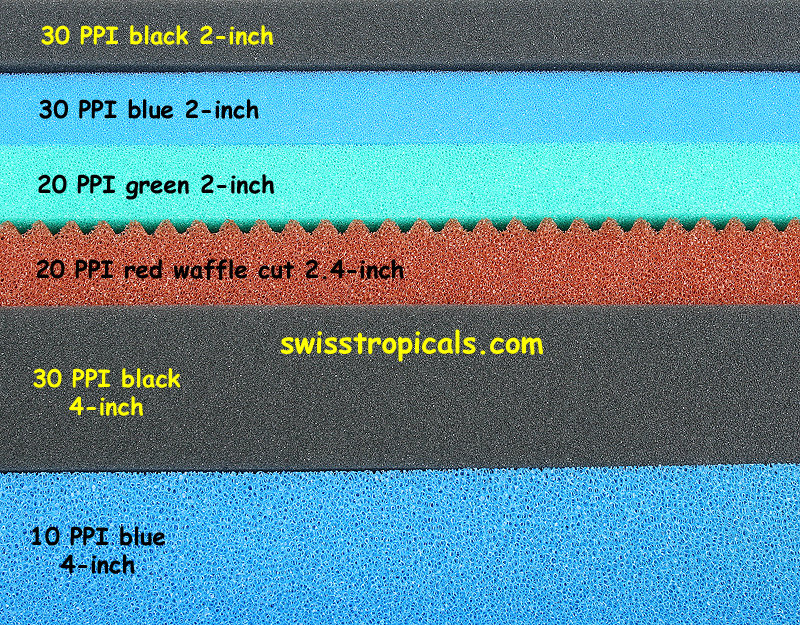
Examples of porosities available:
Thank you for visiting!
all content copyright by the owner of Swiss Tropicals, LLC
Contact: email me.
You are visitor # since April 2008